

What Can I Use To Clean A Antifriction Bearing

A bearing is a motorcar chemical element that constrains relative motion to just the desired move, and reduces friction between moving parts. The blueprint of the bearing may, for example, provide for free linear movement of the moving part or for free rotation around a fixed axis; or, it may preclude a motion by decision-making the vectors of normal forces that behave on the moving parts. Most bearings facilitate the desired movement by minimizing friction. Bearings are classified broadly according to the blazon of functioning, the motions allowed, or to the directions of the loads (forces) applied to the parts.
Rotary bearings hold rotating components such equally shafts or axles within mechanical systems, and transfer axial and radial loads from the source of the load to the construction supporting information technology. The simplest class of bearing, the plain begetting, consists of a shaft rotating in a hole. Lubrication is used to reduce friction. In the ball bearing and roller bearing, to reduce sliding friction, rolling elements such equally rollers or balls with a circular cross-section are located between the races or journals of the bearing assembly. A wide diverseness of bearing designs exists to allow the demands of the application to be correctly met for maximum efficiency, reliability, immovability and performance.
The term "bearing" is derived from the verb "to deport";[1] a bearing being a machine element that allows 1 part to bear (i.east., to support) another. The simplest bearings are bearing surfaces, cut or formed into a role, with varying degrees of command over the form, size, roughness and location of the surface. Other bearings are dissever devices installed into a motorcar or machine role. The almost sophisticated bearings for the well-nigh demanding applications are very precise devices; their manufacture requires some of the highest standards of current engineering science.[ citation needed ]
History [edit]
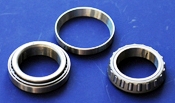

The invention of the rolling bearing, in the form of wooden rollers supporting, or bearing, an object being moved is of nifty antiquity and may predate the invention of a bicycle rotating on a plain bearing used for transportation.[ citation needed ]
Though it is often claimed that the Egyptians used roller bearings in the form of tree trunks under sleds,[ citation needed ] this is mod speculation.[2] [ page needed ] The Egyptians' ain drawings in the tomb of Djehutihotep testify the process of moving massive stone blocks on sledges as using liquid-lubricated runners which would plant apparently bearings.[3] [ page needed ] There are also Egyptian drawings of obviously bearings used with hand drills.[4]
Wheeled vehicles using plain bearings emerged between about 5000 BC and 3000 BC.[ citation needed ]
The earliest recovered example of a rolling chemical element bearing is a wooden brawl begetting supporting a rotating table from the remains of the Roman Nemi ships in Lake Nemi, Italy. The wrecks were dated to 40 BC.[5] [vi]
Leonardo da Vinci incorporated drawings of ball bearings in his pattern for a helicopter around the year 1500. This is the commencement recorded utilize of bearings in an aerospace design. Yet, Agostino Ramelli is the showtime to have published sketches of roller and thrust bearings.[ citation needed ] An issue with brawl and roller bearings is that the balls or rollers rub confronting each other causing additional friction which can be reduced past enclosing the balls or rollers within a cage. The captured, or caged, brawl bearing was originally described past Galileo in the 17th century.[ citation needed ]
The first applied caged-roller bearing was invented in the mid-1740s by horologist John Harrison for his H3 marine timekeeper. This uses the bearing for a very limited oscillating motion but Harrison also used a similar bearing in a truly rotary application in a contemporaneous regulator clock.[ citation needed ]
Industrial era [edit]
The showtime modernistic recorded patent on brawl bearings was awarded to Philip Vaughan, a British inventor and ironmaster who created the first design for a ball bearing in Carmarthen in 1794. His was the get-go modern ball-bearing design, with the ball running forth a groove in the axle associates.[7]
Bearings accept played a pivotal office in the nascent Industrial Revolution, allowing the new industrial machinery to operate efficiently. For example, they saw apply for belongings wheel and axle to greatly reduce friction over that of dragging an object by making the friction human action over a shorter distance as the wheel turned.
The offset plain and rolling-element bearings were wood closely followed by bronze. Over their history bearings have been made of many materials including ceramic, sapphire, glass, steel, bronze, other metals and plastic (due east.g., nylon, polyoxymethylene, polytetrafluoroethylene, and UHMWPE) which are all used today.
Watch makers produce "jeweled" watches using sapphire plain bearings to reduce friction thus allowing more precise time keeping.
Even bones materials tin can accept good immovability. Every bit examples, wooden bearings can still be seen today in erstwhile clocks or in water mills where the water provides cooling and lubrication.
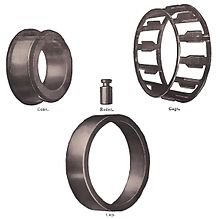
The showtime patent for a radial style brawl bearing was awarded to Jules Suriray, a Parisian bike mechanic, on three August 1869. The bearings were then fitted to the winning bike ridden by James Moore in the world's starting time cycle road race, Paris-Rouen, in November 1869.[8]
In 1883, Friedrich Fischer, founder of FAG, developed an arroyo for milling and grinding balls of equal size and verbal roundness by means of a suitable production machine and formed the foundation for cosmos of an contained bearing industry. His hometown Schweinfurt later became a globe leading center for ball bearing production.

Wingquist original patent of self-aligning ball begetting
The modernistic, self-aligning pattern of ball bearing is attributed to Sven Wingquist of the SKF ball-bearing manufacturer in 1907, when he was awarded Swedish patent No. 25406 on its design.
Henry Timken, a 19th-century visionary and innovator in carriage manufacturing, patented the tapered roller bearing in 1898. The following year he formed a visitor to produce his innovation. Over a century the company grew to make bearings of all types, including specialty steel and an array of related products and services.
Erich Franke invented and patented the wire race bearing in 1934. His focus was on a begetting blueprint with a cross section equally modest as possible and which could exist integrated into the enclosing pattern. After World War Two he founded together with Gerhard Heydrich the company Franke & Heydrich KG (today Franke GmbH) to push the development and production of wire race bearings.
Richard Stribeck'southward extensive inquiry[9] [ten] on ball bearing steels identified the metallurgy of the commonly used 100Cr6 (AISI 52100)[eleven] showing coefficient of friction equally a function of pressure.
Designed in 1968 and later patented in 1972, Bishop-Wisecarver's co-founder Bud Wisecarver created vee groove bearing guide wheels, a type of linear motility begetting consisting of both an external and internal 90-degree vee angle.[12] [ ameliorate source needed ]
In the early 1980s, Pacific Begetting's founder, Robert Schroeder, invented the first bi-material obviously bearing which was size interchangeable with linear ball bearings. This bearing had a metal crush (aluminum, steel or stainless steel) and a layer of Teflon-based material connected by a thin agglutinative layer.[13]
Today brawl and roller bearings are used in many applications which include a rotating component. Examples include ultra high speed bearings in dental drills, aerospace bearings in the Mars Rover, gearbox and wheel bearings on automobiles, flexure bearings in optical alignment systems, cycle cycle hubs, and air bearings used in Coordinate-measuring machines.
Common [edit]
By far, the most common bearing is the manifestly bearing, a bearing which uses surfaces in rubbing contact, ofttimes with a lubricant such as oil or graphite. A plainly bearing may or may non be a discrete device. It may exist nothing more than the bearing surface of a pigsty with a shaft passing through it, or of a planar surface that bears another (in these cases, not a discrete device); or it may be a layer of bearing metallic either fused to the substrate (semi-discrete) or in the form of a separable sleeve (discrete). With suitable lubrication, plain bearings often requite entirely adequate accuracy, life, and friction at minimal price. Therefore, they are very widely used.
Nonetheless, there are many applications where a more suitable bearing tin can improve efficiency, accuracy, service intervals, reliability, speed of operation, size, weight, and costs of purchasing and operating machinery.
Thus, there are many types of bearings, with varying shape, material, lubrication, principle of functioning, and so on.
Types [edit]

Animation of ball bearing (Ideal figure without a cage). The inner ring rotates and the outer ring is stationary.
There are at to the lowest degree 6 common types of bearing,[fourteen] each of which operates on unlike principles:
- Evidently bearing, consisting of a shaft rotating in a pigsty. There are several specific styles: bushing, journal bearing, sleeve bearing, rifle bearing, composite bearing;
- Rolling-chemical element bearing, in which rolling elements placed betwixt the turning and stationary races prevent sliding friction. There are two main types:
- Brawl bearing, in which the rolling elements are spherical balls;
- Roller bearing, in which the rolling elements are cylindrical, taper or spherical rollers;
- Jewel bearing, a plain bearing in which i of the bearing surfaces is fabricated of an ultrahard glassy jewel material such as sapphire to reduce friction and article of clothing;
- Fluid begetting, a noncontact bearing in which the load is supported past a gas or liquid (i.east. air bearing);
- Magnetic bearing, in which the load is supported by a magnetic field;
- Flexure bearing, in which the motion is supported by a load chemical element which bends.
Motions [edit]
Mutual motions permitted by bearings are:
- Radial rotation e.grand. shaft rotation;
- linear movement e.g. drawer;
- spherical rotation east.grand. ball and socket joint;
- hinge motion e.yard. door, elbow, knee.
Friction [edit]
Reducing friction in bearings is oftentimes of import for efficiency, to reduce clothing and to facilitate extended use at high speeds and to avoid overheating and premature failure of the begetting. Substantially, a bearing tin reduce friction by virtue of its shape, by its material, or by introducing and containing a fluid betwixt surfaces or past separating the surfaces with an electromagnetic field.
- By shape, gains advantage usually by using spheres or rollers, or by forming flexure bearings.
- By material, exploits the nature of the begetting material used. (An example would be using plastics that take low surface friction.)
- By fluid, exploits the low viscosity of a layer of fluid, such as a lubricant or as a pressurized medium to continue the two solid parts from touching, or by reducing the normal strength between them.
- By fields, exploits electromagnetic fields, such every bit magnetic fields, to go along solid parts from touching.
- Air pressure level exploits air pressure to go on solid parts from touching.
Combinations of these tin even be employed within the same begetting. An example of this is where the cage is made of plastic, and it separates the rollers/balls, which reduce friction past their shape and finish.
Loads [edit]
Bearing design varies depending on the size and directions of the forces that they are required to back up. Forces can exist predominately radial, axial (thrust bearings), or bending moments perpendicular to the main centrality.
Speeds [edit]
Dissimilar begetting types have unlike operating speed limits. Speed is typically specified as maximum relative surface speeds, ofttimes specified ft/s or m/s. Rotational bearings typically describe operation in terms of the product DN where D is the mean diameter (frequently in mm) of the bearing and Due north is the rotation rate in revolutions per infinitesimal.
Generally, there is considerable speed range overlap betwixt bearing types. Plain bearings typically handle only lower speeds, rolling element bearings are faster, followed by fluid bearings and finally magnetic bearings which are limited ultimately by centripetal force overcoming material strength.
Play [edit]
Some applications apply bearing loads from varying directions and take only limited play or "slop" as the applied load changes. One source of motility is gaps or "play" in the bearing. For case, a 10 mm shaft in a 12 mm hole has 2 mm play.
Commanded play varies greatly depending on the use. As an example, a wheelbarrow cycle supports radial and axial loads. Centric loads may be hundreds of newtons force left or right, and information technology is typically acceptable for the bicycle to wobble by as much every bit 10 mm under the varying load. In contrast, a lathe may position a cutting tool to ±0.002 mm using a ball pb screw held by rotating bearings. The bearings back up axial loads of thousands of newtons in either direction and must agree the ball lead screw to ±0.002 mm across that range of loads
Stiffness [edit]
A second source of motility is elasticity in the bearing itself. For example, the assurance in a ball begetting are like stiff rubber, and under load deform from round to a slightly flattened shape. The race is besides elastic and develops a slight dent where the ball presses on it.
The stiffness of a bearing is how the distance between the parts which are separated by the bearing varies with applied load. With rolling element bearings this is due to the strain of the ball and race. With fluid bearings it is due to how the pressure of the fluid varies with the gap (when correctly loaded, fluid bearings are typically stiffer than rolling element bearings).
Service life [edit]
- Fluid and magnetic bearings
Fluid and magnetic bearings can have practically indefinite service lives. In practice, there are fluid bearings supporting high loads in hydroelectric plants that take been in most continuous service since about 1900 and which evidence no signs of habiliment.[ citation needed ]
- Rolling element bearings
Rolling element begetting life is adamant by load, temperature, maintenance, lubrication, material defects, contamination, handling, installation and other factors. These factors tin can all have a meaning result on begetting life. For instance, the service life of bearings in i awarding was extended dramatically by changing how the bearings were stored before installation and utilize, as vibrations during storage acquired lubricant failure even when the only load on the begetting was its ain weight;[15] the resulting damage is often fake brinelling.[16] Bearing life is statistical: several samples of a given bearing volition often exhibit a bell bend of service life, with a few samples showing significantly better or worse life. Bearing life varies considering microscopic structure and contamination vary greatly even where macroscopically they seem identical.
L10 life [edit]
Bearings are oft specified to give an "L10" life (exterior the Usa, information technology may exist referred to as "B10" life.) This is the life at which ten percent of the bearings in that awarding tin can be expected to take failed due to classical fatigue failure (and not whatsoever other way of failure similar lubrication starvation, wrong mounting etc.), or, alternatively, the life at which 90 pct will still be operating. The L10 life of the begetting is theoretical life and may not stand for service life of the begetting. Bearings are besides rated using C0 (static loading) value. This is the basic load rating as a reference, and not an actual load value.
- Plain bearings
For plain bearings, some materials give much longer life than others. Some of the John Harrison clocks still operate afterward hundreds of years considering of the lignum vitae wood employed in their construction, whereas his metal clocks are seldom run due to potential wear.
- Flexure bearings
Flexure bearings rely on rubberband properties of a material. Flexure bearings bend a slice of fabric repeatedly. Some materials fail after repeated angle, even at depression loads, just careful material option and bearing design can make flexure bearing life indefinite.
- Short-life bearings
Although long bearing life is often desirable, it is sometimes not necessary. Harris 2001 describes a bearing for a rocket motor oxygen pump that gave several hours life, far in backlog of the several tens of minutes life needed.[15]
Composite bearings
Depending on the customized specifications (backing material and PTFE compounds), composite bearings tin can operate up to 30 years without maintenance.
Oscillating bearings
For bearings which are used in oscillating applications, customized approaches to calculate L10 are used.[17]
External factors [edit]
The service life of the bearing is afflicted past many parameters that are not controlled by the begetting manufacturers. For example, begetting mounting, temperature, exposure to external environment, lubricant cleanliness and electrical currents through bearings etc. High frequency PWM inverters can induce currents in a begetting, which can be suppressed by the use of ferrite chokes.
The temperature and terrain of the micro-surface volition determine the amount of friction by the touching of solid parts.
Certain elements and fields reduce friction while increasing speeds.
Strength and mobility assist determine the amount of load the bearing type can carry.
Alignment factors can play a damaging role in wearable and tear, nevertheless overcome past computer aid signaling and non-rubbing bearing types, such every bit magnetic levitation or air field pressure level.
Mounting [edit]
There are many methods of mounting bearings, usually involving an interference fit.[eighteen] When press fitting or compress plumbing equipment a bearing into a diameter or onto a shaft, information technology'southward important to keep the housing diameter and shaft outer diameter to very close limits, which can involve one or more counterboring operations, several facing operations, and drilling, tapping, and threading operations.[xix] Alternatively, an interference fit can also be achieved with the add-on of a tolerance ring.
Maintenance and lubrication [edit]
Many bearings require periodic maintenance to prevent premature failure, but many others require little maintenance. The latter include various kinds of polymer, fluid and magnetic bearings, as well every bit rolling-element bearings that are described with terms including sealed bearing and sealed for life. These contain seals to keep the clay out and the grease in. They work successfully in many applications, providing maintenance-costless performance. Some applications cannot use them effectively.
Nonsealed bearings frequently have a grease plumbing equipment, for periodic lubrication with a grease gun, or an oil loving cup for periodic filling with oil. Before the 1970s, sealed bearings were non encountered on most machinery, and oiling and greasing were a more common activity than they are today. For example, automotive chassis used to crave "lube jobs" most as often as engine oil changes, simply today's car chassis are more often than not sealed for life. From the tardily 1700s through the mid-1900s, manufacture relied on many workers called oilers to lubricate machinery frequently with oil cans.
Factory machines today usually have lube systems, in which a key pump serves periodic charges of oil or grease from a reservoir through lube lines to the various lube points in the motorcar'due south bearing surfaces, bearing journals, pillow blocks, and then on. The timing and number of such lube cycles is controlled by the car'due south computerized control, such as PLC or CNC, too as by manual override functions when occasionally needed. This automated procedure is how all modern CNC motorcar tools and many other modern factory machines are lubricated. Similar lube systems are also used on nonautomated machines, in which instance at that place is a hand pump that a machine operator is supposed to pump one time daily (for machines in constant utilise) or once weekly. These are chosen one-shot systems from their principal selling betoken: i pull on one handle to lube the whole machine, instead of a dozen pumps of an alemite gun or oil can in a dozen different positions effectually the automobile.
The oiling organization inside a modern automotive or truck engine is similar in concept to the lube systems mentioned in a higher place, except that oil is pumped continuously. Much of this oil flows through passages drilled or cast into the engine block and cylinder heads, escaping through ports straight onto bearings, and squirting elsewhere to provide an oil bath. The oil pump simply pumps constantly, and any excess pumped oil continuously escapes through a relief valve back into the sump.
Many bearings in high-cycle industrial operations demand periodic lubrication and cleaning, and many crave occasional aligning, such as pre-load adjustment, to minimize the effects of wear.
Bearing life is frequently much better when the bearing is kept clean and well lubricated. However, many applications make practiced maintenance difficult. I instance is bearings in the conveyor of a stone crusher are exposed continually to hard annoying particles. Cleaning is of footling employ because cleaning is expensive yet the bearing is contaminated again as soon equally the conveyor resumes operation. Thus, a good maintenance program might lubricate the bearings frequently but not include any disassembly for cleaning. The frequent lubrication, past its nature, provides a limited kind of cleaning activeness, by displacing older (grit-filled) oil or grease with a fresh charge, which itself collects grit before being displaced by the adjacent cycle. Another example are bearings in wind turbines, which makes maintenance difficult since the nacelle is placed high up in the air in strong wind areas. In addition, the turbine does not always run and is subjected to different operating behavior in unlike weather conditions, which makes proper lubrication a claiming.[20]
Rolling-element begetting outer race mistake detection [edit]
Rolling-chemical element bearings are widely used in the industries today, and hence maintenance of these bearings becomes an important task for the maintenance professionals. The rolling-element bearings wear out hands due to metallic-to-metal contact, which creates faults in the outer race, inner race and ball. It is also the most vulnerable component of a machine considering it is often under high load and loftier running speed conditions. Regular diagnostics of rolling-element bearing faults is disquisitional for industrial safety and operations of the machines forth with reducing the maintenance costs or avoiding shutdown fourth dimension. Amid the outer race, inner race and ball, the outer race tends to be more vulnerable to faults and defects.
At that place is still room for discussion as to whether the rolling element excites the natural frequencies of begetting component when it passes the fault on the outer race. Hence we demand to identify the bearing outer race natural frequency and its harmonics. The bearing faults create impulses and results in stiff harmonics of the fault frequencies in the spectrum of vibration signals. These fault frequencies are sometimes masked by adjacent frequencies in the spectra due to their little energy. Hence, a very high spectral resolution is ofttimes needed to identify these frequencies during a FFT assay. The natural frequencies of a rolling chemical element bearing with the gratuitous boundary conditions are 3 kHz. Therefore, in order to use the begetting component resonance bandwidth method to observe the bearing mistake at an initial phase a high frequency range accelerometer should be adopted, and information obtained from a long duration needs to exist caused. A mistake characteristic frequency can only be identified when the fault extent is severe, such as that of the presence of a hole in the outer race. The harmonics of error frequency is a more than sensitive indicator of a bearing outer race fault. For a more than serious detection of defected bearing faults waveform, spectrum and envelope techniques will help reveal these faults. However, if a high frequency demodulation is used in the envelope analysis in social club to detect bearing fault characteristic frequencies, the maintenance professionals take to be more than careful in the assay because of resonance, every bit it may or may non contain mistake frequency components.
Using spectral assay as a tool to identify the faults in the bearings faces challenges due to problems like low energy, signal smearing, cyclostationarity etc. High resolution is often desired to differentiate the error frequency components from the other loftier-amplitude adjacent frequencies. Hence, when the signal is sampled for FFT analysis, the sample length should be large plenty to requite adequate frequency resolution in the spectrum. Also, keeping the computation fourth dimension and memory within limits and avoiding unwanted aliasing may exist enervating. Yet, a minimal frequency resolution required can exist obtained past estimating the bearing error frequencies and other vibration frequency components and its harmonics due to shaft speed, misalignment, line frequency, gearbox etc.
Packing [edit]
Some bearings use a thick grease for lubrication, which is pushed into the gaps between the begetting surfaces, too known as packing. The grease is held in identify past a plastic, leather, or rubber gasket (as well called a gland) that covers the inside and outside edges of the begetting race to keep the grease from escaping.
Bearings may also be packed with other materials. Historically, the wheels on railroad cars used sleeve bearings packed with waste or loose scraps of cotton wool or wool fiber soaked in oil, so afterwards used solid pads of cotton.[21]
Ring oiler [edit]
Bearings tin exist lubricated by a metallic ring that rides loosely on the key rotating shaft of the bearing. The ring hangs downwards into a sleeping room containing lubricating oil. As the bearing rotates, viscous adhesion draws oil up the ring and onto the shaft, where the oil migrates into the bearing to lubricate information technology. Excess oil is flung off and collects in the pool again.[22]
Splash lubrication [edit]
A rudimentary form of lubrication is splash lubrication. Some machines contain a pool of lubricant in the bottom, with gears partially immersed in the liquid, or crank rods that can swing down into the pool as the device operates. The spinning wheels fling oil into the air around them, while the crank rods slap at the surface of the oil, splashing it randomly on the interior surfaces of the engine. Some pocket-sized internal combustion engines specifically contain special plastic flinger wheels which randomly scatter oil around the interior of the mechanism.[23]
Pressure level lubrication [edit]
For loftier speed and loftier ability machines, a loss of lubricant can result in rapid begetting heating and damage due to friction. Also in dirty environments, the oil can become contaminated with dust or debris that increases friction. In these applications, a fresh supply of lubricant tin be continuously supplied to the bearing and all other contact surfaces, and the excess can be collected for filtration, cooling, and perchance reuse. Force per unit area oiling is commonly used in big and circuitous internal combustion engines in parts of the engine where directly splashed oil cannot accomplish, such as up into overhead valve assemblies.[24] High speed turbochargers also typically crave a pressurized oil system to absurd the bearings and go along them from called-for up due to the rut from the turbine.
Composite bearings [edit]
Composite bearings are designed with a cocky-lubricating polytetrafluroethylene (PTFE) liner with a laminated metal backing. The PTFE liner offers consistent, controlled friction also every bit durability whilst the metal backing ensures the composite bearing is robust and capable of withstanding high loads and stresses throughout its long life. Its blueprint also makes it lightweight-one 10th the weight of a traditional rolling element begetting.[25]
Types [edit]
In that location are many different types of bearings. Newer versions of more enabling designs are in evolution beingness tested, which volition reduce friction, increase bearing load, increase momentum build-upward, and speed.
| Blazon | Clarification | Friction | Stiffness† | Speed | Life | Notes |
|---|---|---|---|---|---|---|
| Manifestly bearing | Rubbing surfaces, usually with lubricant; some bearings use pumped lubrication and deport similarly to fluid bearings. | Depends on materials and construction, PTFE has a coefficient of friction ~0.05–0.35, depending upon fillers added | Good, provided article of clothing is low, but some slack is normally present | Depression to very high | Low to very high – depends upon application and lubrication | Widely used, relatively high friction, suffers from stiction in some applications. Depending upon the application, the lifetime can be higher or lower than rolling element bearings. |
| Rolling element bearing | Brawl or rollers are used to foreclose or minimise rubbing | Rolling coefficient of friction with steel can be ~0.005 (adding resistance due to seals, packed grease, preload and misalignment can increase friction to as much as 0.125) | Good, but some slack is ordinarily nowadays | Moderate to high (often requires cooling) | Moderate to high (depends on lubrication, often requires maintenance) | Used for higher moment loads than plain bearings with lower friction |
| Jewel begetting | Off-center bearing rolls in seating | Low | Depression due to flexing | Low | Acceptable (requires maintenance) | Mainly used in depression-load, high precision work such every bit clocks. Precious stone bearings may exist very small. |
| Fluid bearing | Fluid is forced between two faces and held in by border seal | Zilch friction at nil speed, low | Very high | Very loftier (usually express to a few hundred anxiety per second at/by seal) | About infinite in some applications, may wear at startup/shutdown in some cases. Often negligible maintenance. | Can neglect quickly due to grit or dust or other contaminants. Maintenance free in continuous use. Can handle very large loads with depression friction. |
| Magnetic bearing | Faces of bearing are kept divide by magnets (electromagnets or eddy currents) | Zero friction at zero speed, but constant power for levitation, eddy currents are oft induced when motion occurs, merely may be negligible if magnetic field is quasi-static | Low | No practical limit | Indefinite. Maintenance free. (with electromagnets) | Agile magnetic bearings (AMB) demand considerable ability. Electrodynamic bearings (EDB) practice not require external power. |
| Flexure bearing | Material flexes to requite and constrain motion | Very depression | Depression | Very high. | Very loftier or low depending on materials and strain in application. Commonly maintenance gratuitous. | Limited range of movement, no backfire, extremely smooth motion |
| Composite bearing | Patently bearing shape with PTFE liner on the interface betwixt bearing and shaft with a laminated metallic bankroll. PTFE acts equally a lubricant. | PTFE and utilize of filters to dial in friction every bit necessary for friction control. | Adept depending on laminated metal bankroll | Low to very loftier | Very high; PTFE and fillers ensure wear and corrosion resistance | Widely used, controls friction, reduces stick slip, PTFE reduces static friction |
| †Stiffness is the amount that the gap varies when the load on the bearing changes, information technology is distinct from the friction of the bearing. | ||||||
Encounter also [edit]
- Axlebox
- Ball bearing – Blazon of rolling-element bearing
- Ball spline – Type of linear motion bearing that can transmit torque
- Span begetting
- Contact mechanics – Written report of the deformation of solids that affect each other
- Periodical begetting – Simplest type of begetting, comprising just a begetting surface and no rolling elements
- Swivel – Mechanical bearing connecting two objects
- Main bearing
- Needle roller begetting
- Pillow block bearing
- Pitch begetting – Component connecting a turbine blade to the hub assuasive pitch variation
- Patently bearing – Simplest type of bearing, comprising but a bearing surface and no rolling elements
- Pot bearing
- Race (begetting) – Rails in a bearing along which the rolling elements ride
- Rolamite – Depression friction bearing engineering
- Rolling-element begetting
- Scrollerwheel
- Shock pulse method
- Slewing bearing – Rotational back up chemical element for directional alignment
- Spherical apparently bearing – Bearing that permit limited angular rotation orthogonal to the shaft centrality
- Spherical roller bearing – Rolling-chemical element bearing that tolerates angular misalignment
- Screw groove begetting – Hydrodynamic bearings using spiral grooves to develop lubricant pressure
References [edit]
- ^ Merriam-Webster, "headwords "bearing" and "bear"", Merriam-Webster's Collegiate Lexicon, online subscription version
- ^ Bunch, Bryan H.; Hellemans, Alexander (2004). The History of Scientific discipline and Technology: A Browser's Guide to the Great Discoveries, Inventions, and the People who Fabricated Them, from the Dawn of Time to Today. ISBN978-0-618-22123-iii.
- ^ Bard, Kathryn A.; Shubert, Steven Blake. Encyclopedia of the Archæology of Ancient Egypt.
- ^ Guran, Ardéshir; Rand, Richard H. (1997), Nonlinear dynamics, Earth Scientific, p. 178, ISBN978-981-02-2982-5
- ^ Purtell, John (1999/2001). Project Diana, affiliate 10: Wonders from the classical historic period. Archived one July 2022 at the Wayback Automobile
- ^ "Bearing Industry Timeline". americanbearings.org. Archived from the original on 28 Dec 2022. Retrieved 21 October 2022.
- ^ "Double- Row Angular Contact Ball Bearings". intechbearing.com. Archived from the original on eleven May 2022.
- ^ "Bike History, Chronology of the Growth of Bicycling and the Development of Bicycle Technology by David Mozer". Ibike.org. Retrieved thirty September 2022.
- ^ Stribeck, R. (1901). "Kugellager für beliebige Belastungen". Zeitschrift des Vereines Deutscher Ingenieure. 3 (45): 73–79.
- ^ Stribeck, R. (1 July 1901). "Kugellager (ball bearings)". Glasers Annalen für Gewerbe und Bauwesen. 577: 2–9.
- ^ Martens, A. (1888). Schmieröluntersuchungen (Investigations on oils). Mitteilungen aus den Königlichen technischen Versuchsanstalten zu Berlin, Ergänzungsheft Three. Berlin: Verlag von Julius Springer. pp. 1–57. Archived from the original on 25 Feb 2022.
- ^ Machine Design (2007), Did You Know: Bud Wisecarver (PDF), Automobile Design, p. 1
- ^ "Design News Magazine – July 1995". [ permanent dead link ]
- ^ "6 Most Popular Types of Mechanical Bearings". craftechind.com. 22 January 2022.
- ^ a b Harris, Tedric A. (2001). Rolling bearing analysis. Wiley. ISBN978-0-471-35457-iv.
- ^ Schwack, Fabian; Byckov, Artjom; Bader, Norbert; Poll, Gerhard, "Time-dependent analyses of wear in oscillating begetting applications", Proceedings of the STLE/ASME International Joint Tribology Conference, S2CID 201816405
- ^ Schwack, F.; Stammler, M.; Poll, G.; Reuter, A. (2016). "Comparison of Life Calculations for Aquiver Bearings Considering Individual Pitch Control in Current of air Turbines". Journal of Physics: Conference Series. 753 (xi): 112013. Bibcode:2016JPhCS.753k2013S. doi:10.1088/1742-6596/753/eleven/112013.
- ^ "Antifriction Bearings - an overview | ScienceDirect Topics". www.sciencedirect.com.
- ^ Budynas, Richard; Nisbett, J. Keith (27 January 2022). Shigley's Mechanical Applied science Blueprint. McGraw Hill. p. 597. ISBN978-0-07-339820-4.
- ^ Schwack, Fabian; Bader, Norbert; Leckner, Johan; Demaille, Claire; Poll, Gerhard (2020). "A report of grease lubricants under wind turbine pitch bearing conditions". Wear. 454–455: 203335. doi:x.1016/j.wear.2020.203335. ISSN 0043-1648.
- ^ White, John H. (1985) [1978]. The American Railroad Passenger Car. Vol. 2. Baltimore, Maryland: Johns Hopkins Academy Press. p. 518. ISBN978-0-8018-2747-ane.
- ^ Gebhardt, George Frederick (1917). Steam Power Institute Engineering science. J. Wiley. p. 791.
- ^ Hobbs, George William; Elliott, Ben George; Consoliver, Earl Lester (1919). The gasoline automobile. McGraw-Hill. pp. 111–114.
- ^ Dumas, Paul (14 September 1922). "Pressure Lubricating Characteristics". Motor Age. Form Journal Co. 42.
- ^ Gobain, Saint (one June 2022). "Saint-Gobain and Norco Get Celebrity Thumbs-Up". Retrieved 9 June 2022.
External links [edit]
 | Wikimedia Eatables has media related to Bearings. |
- ISO Dimensional arrangement and begetting numbers
- Comprehensive review on bearings, University of Cambridge
- A glossary of begetting terms
- How bearings work
- Kinematic Models for Blueprint Digital Library (KMODDL) – Movies and photos of hundreds of working mechanical-systems models at Cornell University. Also includes an e-book library of archetype texts on mechanical design and engineering.
- Types of bearings, Cambridge Academy

Source: https://en.wikipedia.org/wiki/Bearing_(mechanical)
Posted by: evanssiond1998.blogspot.com
0 Response to "What Can I Use To Clean A Antifriction Bearing"
Post a Comment